The ongoing miniaturisation of electronic components presents the highest demands for visual inspection. SMD components, circuit traces, and solder joints are barely visible to the naked eye. Professional stereo microscopes make the invisible visible and turn electronics manufacturing from guesswork into controlled precision.
Daylight Quality
The LEDone light source provides daylight-quality illumination. Colour coding, labels, and solder joints appear in natural colours, which is crucial for the accurate assessment of electronic components.
Fast Magnification Change
The manual magnification switch allows rapid transitions between overview and detailed view. There is no interruption to work, and no need to change lenses.
Compact Design
The SLM 2 with a base plate measuring 300 x 400 mm adapts to any space. The desktop microscope can be easily and quickly used for a variety of tasks in different rooms.
Space-Saving Storage
The SOM 82 can be stored compactly and securely in an aluminium case when not in use. Ideal for workshops with varying space requirements.
Documentation Integrable
With an optional DSLR phototube for Canon and Nikon, findings can be documented. Multicoated anti-reflective high-end optics for full-frame, low-distortion digital images.
SLM 2
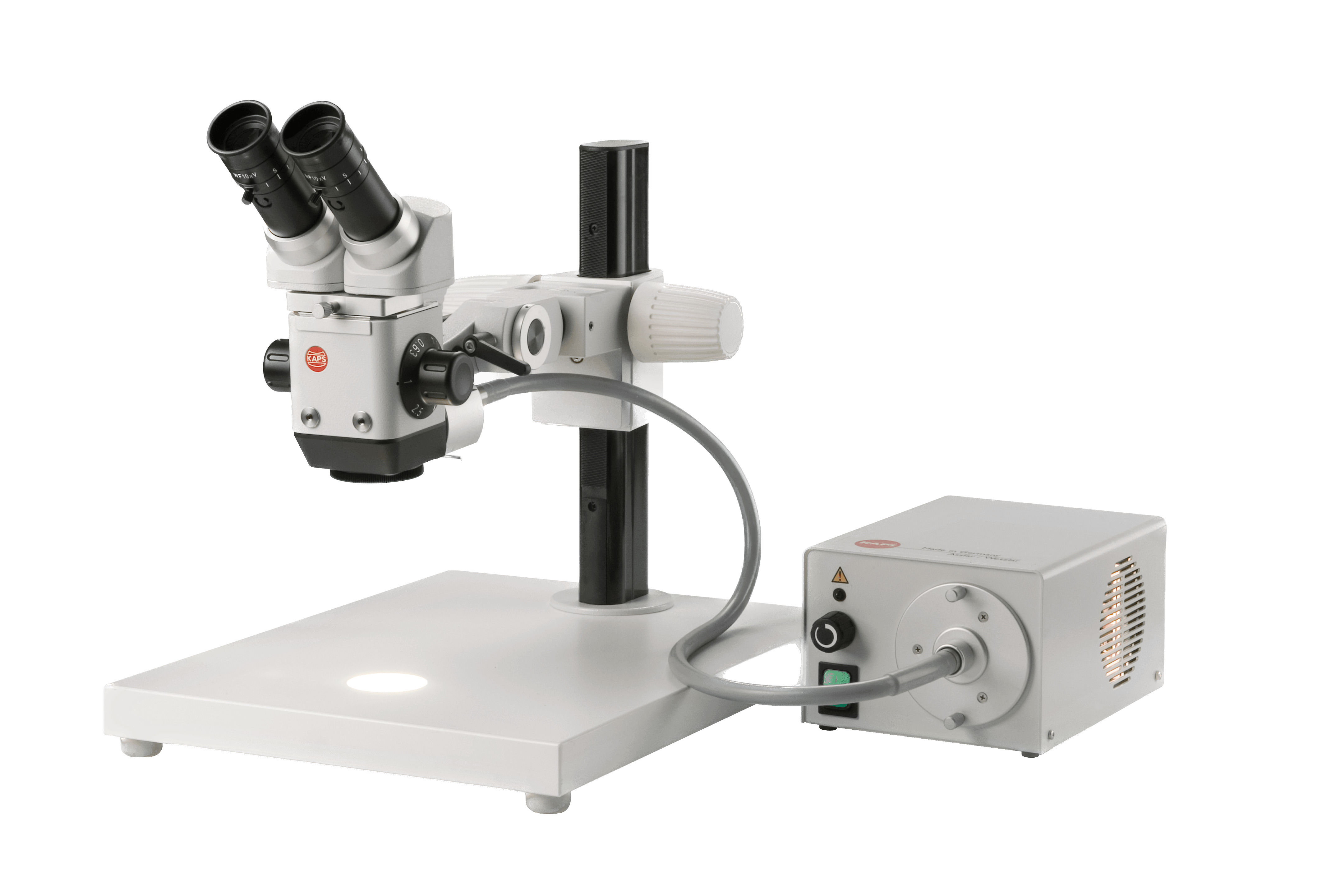
The compact version for electronic workstations with limited space. The base plate provides sufficient room for circuit boards and tools, and the focusing drive allows quick adjustment to different component heights.
Technical Specifications:
Base plate: 300 x 400 mm, scratch-resistant coating
Focusing drive: 300 mm
Stand column: Stainless steel with clamp
Magnification: 3-step manual changer (standard), 5-step optional
Objectives: f=150 mm, f=200 mm
Lighting: LEDone (daylight quality)
Focusing: Manual fine focusing
Binocular tube: Inclined tube f=159 mm 60° (standard)
Eyepieces: 10x V, 12.5x V, or 20x V
SLM 1
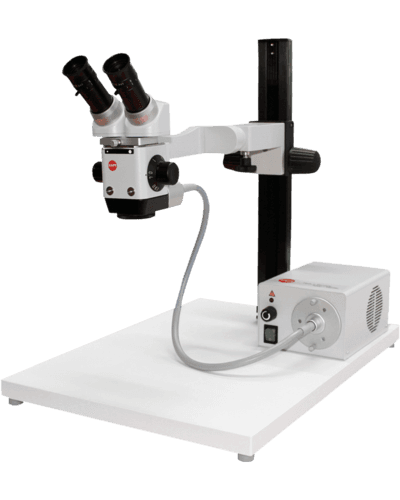
The larger desktop microscope for workstations with larger assemblies or multiple circuit boards at the same time. The large base plate provides room for more extensive testing and repair tasks.
Technical specifications:
Base plate: 420 x 600 mm, scratch-resistant coating
Focusing drive: 500 mm
Magnification: Manual 3-step changer (Standard), 5-step optional
Objectives: f=150 mm, f=200 mm
Lighting: LEDone (daylight quality)
Binocular tube: Inclined tube f=159 mm 60° (Standard), optional 45° or wide-angle swing tube 0-210°
Discover which microscope is best suited for each application


" height="23.911999999999992px" id="ciRDaKJH5" width="24px"/></svg>)
" height="24.001568659739974px" id="xPNhzvnO9" width="24.00000164526171px"/></svg>)
" height="15.756141176470578px" id="tPH3We2uY" width="24px"/></svg>)
" height="24px" id="zQPxYS9vz" width="24px"/></svg>)